Controlled Chaos: How Disciplined Traders Turn Volatility Spikes Into Calculated Wins
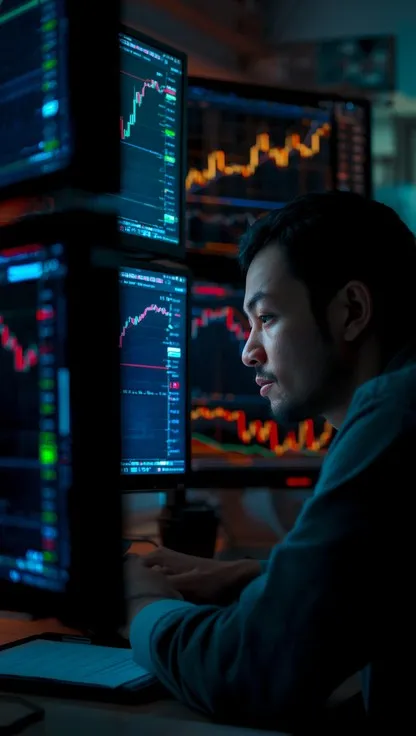
Photo: forex trader analyzing volatile currency charts with multiple screens in dark trading room, via images.stockcake.com
Every seasoned forex trader has lived through at least one moment where the market seemed to lose its mind. A surprise Federal Reserve statement. A geopolitical flashpoint erupting overnight. An inflation print that blindsided consensus forecasts. In those moments, price charts begin moving in ways that feel irrational — spreads widen, stop-losses trigger in rapid succession, and social media fills with traders lamenting catastrophic losses.
But buried inside that disorder is something valuable: pattern. And pattern, for a disciplined trader, means opportunity.
Volatility is not the enemy of profitable trading. Mismanaged volatility is. Understanding the difference between those two things is where the real edge begins.
What Volatility Actually Measures — And Why Most Traders Read It Wrong
In its most fundamental form, volatility measures the rate and magnitude of price change over a defined period. In forex, this is typically expressed through tools like Average True Range (ATR), Bollinger Bands, or implied volatility derived from options pricing on major currency pairs.
The mistake many retail traders make is treating a high-volatility reading as a warning sign to step back. In reality, elevated volatility signals something more nuanced: the market is in the process of repricing. A repricing event — whether triggered by a central bank pivot, an unexpected Non-Farm Payrolls figure, or a geopolitical shock — creates directional momentum that, if entered correctly, can produce outsized returns in compressed timeframes.
Consider how ATR functions in practice. When the 14-period ATR on EUR/USD expands from 60 pips to 120 pips in the span of two sessions, that doubling doesn't simply mean the pair is more dangerous to trade. It means the pair is covering more ground per candle, which translates directly into larger potential gains for traders who are positioned correctly and managing their exposure with precision.
Implied volatility, derived from currency options markets, offers a forward-looking dimension that ATR cannot. When options traders are pricing in significant movement ahead of a known catalyst — a Federal Open Market Committee decision, a presidential election result, a critical CPI release — implied volatility rises. Tracking this metric gives active traders a preview of where institutional money expects turbulence to emerge.
Recognizable Patterns Inside the Noise
One of the more counterintuitive realities of volatile markets is that they frequently produce highly recognizable price structures. The initial spike following a surprise event often overshoots fair value, driven by algorithmic responses and panic-driven retail liquidations. What follows — sometimes within minutes, sometimes over a few hours — is a mean-reversion move as institutional participants step in to fade the overextension.
The 2023 banking sector stress in the United States illustrated this dynamic clearly. As concerns around regional bank stability rattled investor confidence in March of that year, the U.S. dollar experienced sharp, erratic swings against the Japanese yen and Swiss franc — both traditional safe-haven currencies. Traders who recognized the initial USD/JPY sell-off as an overcorrection relative to the actual scope of the crisis were positioned to capture the subsequent rebound as the Federal Reserve moved to stabilize sentiment.
Similarly, when the Bank of Japan unexpectedly adjusted its yield curve control policy in late 2022, USD/JPY dropped precipitously within a single session. The traders who profited weren't necessarily those who predicted the policy shift — they were the ones who had volatility-aware frameworks in place that allowed them to act decisively on the resulting price dislocation rather than standing paralyzed at their screens.
The pattern across these events is consistent: an initial, often exaggerated move, followed by partial retracement, followed by a more sustained trend as the market absorbs the new information and establishes a revised directional bias.
Building a Volatility-Aware Trading Framework
Trading confidently during high-volatility periods requires structural preparation, not just situational courage. Several practical elements form the foundation of a volatility-aware approach.
Position sizing must contract as volatility expands. This is the most critical and most frequently ignored adjustment. If your standard position assumes a 50-pip stop-loss and the market is now moving 150 pips in a single candle, your exposure has tripled in real terms without any change to your nominal position size. Recalibrating position size against current ATR readings — rather than fixed pip targets — keeps actual risk consistent regardless of market conditions.
Entry timing matters more during volatile periods than during calm ones. Entering at the height of a volatility spike, chasing a move already in progress, dramatically reduces the probability of a favorable risk-reward outcome. Waiting for initial momentum to exhaust — watching for candlestick patterns such as wicks, engulfing structures, or inside bars on shorter timeframes — allows for entries that are better defined and more defensible.
Wider stops must be offset by reduced size, not accepted as greater risk. Many traders instinctively widen their stop-losses during volatile conditions without adjusting their position size. This is a compounding error. The correct response is to widen the stop only to the degree technically justified, and to reduce size proportionally so that the total dollar risk per trade remains within predefined parameters.
The Psychological Component That Separates Profitable Traders
Technical frameworks alone are insufficient. The trader who understands ATR, implied volatility, and mean-reversion structures but cannot manage their own emotional response to a fast-moving market will still underperform.
Volatility triggers a well-documented psychological response: loss aversion intensifies, decision-making accelerates, and the temptation to either over-trade or abandon positions prematurely increases substantially. Traders who have not rehearsed their response to these conditions — through scenario planning, defined rules, and regular review of past behavior under stress — tend to revert to reactive, instinct-driven decisions at precisely the moments when deliberate thinking is most valuable.
One practical approach is to develop a volatility playbook in advance. Before a scheduled high-impact event — a Fed meeting, a jobs report, a major geopolitical development — write out the specific price levels, entry criteria, and exit rules you will follow under each plausible scenario. Committing to a framework before the adrenaline kicks in dramatically improves execution quality when the moment arrives.
Traders who have operated through multiple cycles of market dislocation consistently report the same insight: the discomfort of acting during chaos never fully disappears, but it becomes manageable once you recognize it as a signal that opportunity is present rather than a reason to disengage.
Finding the Sweet Spot Between Recklessness and Paralysis
The goal is not to seek out volatility for its own sake, nor to retreat from it reflexively. The goal is to develop the analytical tools and psychological discipline to operate effectively within it — to recognize when a spike represents a genuine, tradable pattern versus when it represents noise that is best left alone.
Not every volatile session deserves a position. Some events produce genuine, sustained dislocations. Others produce only noise. The distinction often becomes clearer in the second and third hour after a major event than it does in the first frantic minutes. Patience, in this context, is not passivity — it is a form of precision.
For active forex traders, volatility is not a threat to be managed away. It is the mechanism through which the market creates its most significant and rapid price movements. The traders who understand how to measure it, anticipate its patterns, size their positions appropriately, and manage their own psychological responses to it are the ones who will consistently find themselves on the right side of the market's most consequential moments.