Before the Headlines Break: How Geopolitical Fault Lines Signal Forex Moves Weeks in Advance
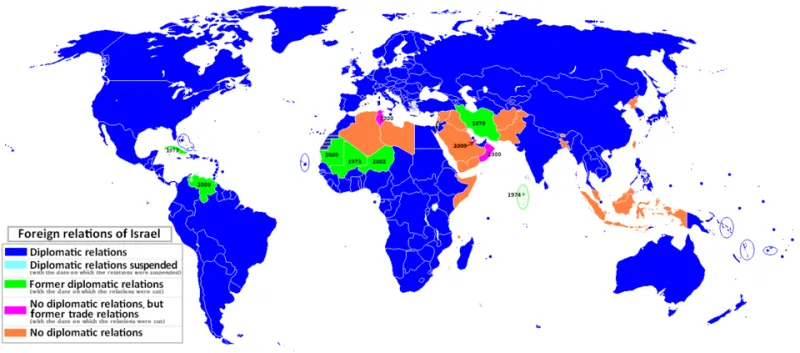
Photo: MehdiBitw98, CC BY-SA 4.0, via Wikimedia Commons
Most retail traders treat geopolitical events as disruptions — sudden shocks that blow up carefully constructed setups and force reactive pivots. But the traders consistently generating alpha in the forex market understand something fundamentally different: geopolitical risk is rarely sudden. It is almost always telegraphed, layer by layer, through policy language, diplomatic posturing, legislative calendars, and trade data — weeks, sometimes months, before a single mainstream outlet runs the story.
For American traders operating in the world's most liquid financial market, developing a geopolitical radar is not optional. It is a competitive necessity.
Why Geopolitical Events Are Leading Indicators, Not Black Swans
The term "black swan" gets applied far too liberally in financial media. Genuine black swans — events with no prior signal and catastrophic impact — are exceptionally rare. Trade wars, sanctions regimes, and diplomatic breakdowns almost universally follow a recognizable escalation pattern.
Consider the architecture of a typical sanctions campaign. Months before formal designations are announced, the following sequence tends to unfold: Congressional hearings introduce the target country or entity into the legislative record. Treasury Department officials deliver carefully worded warnings in public testimony. Allied governments begin coordinating through back-channel communications that eventually surface in foreign press outlets. Export control discussions appear in regulatory filings and Federal Register notices.
For the attentive trader, each of these stages represents an opportunity to assess currency exposure and build directional positioning before the formal announcement triggers a crowded, volatile rush.
The 2018 Trade War Playbook: A Case Study in Early Detection
The U.S.-China trade war of 2018 is frequently described as a market surprise. In reality, the groundwork was laid in plain sight throughout late 2017 and early 2018. The Section 301 investigation into Chinese intellectual property practices — initiated in August 2017 — was a matter of public record. The U.S. Trade Representative's office published updates on its findings. Congressional pressure for retaliatory tariffs was building visibly across multiple committees.
Traders who monitored these signals had a meaningful window before the first tariff announcements formally rattled markets in March 2018. The Chinese yuan (CNY) began exhibiting subtle weakness against the dollar in February of that year, as capital flow data and corporate hedging activity in the offshore yuan market (CNH) started reflecting elevated uncertainty. By the time mainstream financial media declared a trade war, the most favorable entry points had already closed.
The lesson is not that the news was irrelevant. It is that the news confirmed what the early indicators had already suggested.
Sanctions Signals and Emerging Market Currency Vulnerability
Sanctions targeting is another area where the geopolitical-to-forex pipeline is remarkably consistent. When the United States moves toward imposing sanctions on a sovereign nation or major financial institution, the affected country's currency typically begins deteriorating before formal designation.
The Russian ruble provides a particularly instructive example. Following Russia's annexation of Crimea in 2014, the ruble's initial collapse was widely reported as a shock event. However, traders monitoring State Department rhetoric, NATO communiqués, and the legislative progress of the Ukraine Freedom Support Act had substantial advance notice that punitive economic measures were imminent. The ruble's vulnerability was not hidden — it was embedded in the geopolitical trajectory.
More recently, the period leading up to the sweeping 2022 sanctions on Russia following the invasion of Ukraine followed a similar pattern. U.S. and European officials spent weeks publicly warning of "unprecedented" consequences. The ruble and Russian equity markets began pricing in risk before the invasion itself, let alone the formal sanctions packages. Traders positioned short on the ruble ahead of the invasion's confirmation captured some of the most dramatic moves in emerging market forex history.
Building a Geopolitical Monitoring Framework
The practical challenge for most traders is not recognizing that geopolitical signals matter — it is building a systematic process for capturing them without drowning in noise. The following framework offers a structured starting point.
Tier 1: Legislative and Regulatory Tracking Monitor the Congressional Record, Federal Register, and USTR public filings for emerging trade disputes, proposed tariff actions, and export control expansions. These documents are publicly accessible and frequently surface material information well ahead of press coverage.
Tier 2: Official Diplomatic Language Analysis Pay close attention to the language used in State Department press briefings, G7 communiqués, and UN Security Council statements. Shifts from "concerned" to "deeply concerned" to "unacceptable" are not semantic noise — they represent escalation rungs on a predictable ladder. Each rung corresponds to an increased probability of formal economic action.
Tier 3: Allied Press and Foreign-Language Sources U.S.-centric traders frequently overlook the value of monitoring allied foreign press — particularly outlets in the UK, Germany, Japan, and South Korea — where diplomatic developments often surface earlier than in domestic American media. Reuters and Bloomberg international desks, the Financial Times, and regional wire services are particularly valuable.
Tier 4: Capital Flow and Options Market Signals Geopolitical stress tends to appear in options skew and implied volatility surfaces before it shows up in spot prices. A sudden increase in demand for put options on an emerging market currency — or a spike in three-month implied volatility on a currency pair — often reflects institutional hedging activity driven by non-public geopolitical intelligence. These signals are worth incorporating into any monitoring dashboard.
Currency Pairs Most Sensitive to Geopolitical Positioning
Not all currency pairs respond equally to geopolitical stress. For U.S.-based traders, the following pairs warrant particular attention when geopolitical risk is elevated:
- USD/CNH: Highly sensitive to U.S.-China trade policy developments and technology export controls.
- USD/RUB: Directly correlated to Western sanctions posture and energy market dynamics.
- USD/TRY: Responds sharply to NATO-related tensions and U.S.-Turkey diplomatic friction.
- USD/KRW: Reflects North Korean provocations, U.S.-South Korea alliance dynamics, and broader Asian trade risk.
- EUR/USD: Sensitive to transatlantic trade disputes, NATO burden-sharing debates, and European energy security concerns.
Each of these pairs has demonstrated consistent, historically traceable patterns around geopolitical escalation cycles — patterns that reward the disciplined trader who does the upstream research.
The Discipline of Positioning Ahead of Confirmation
There is an important distinction between informed early positioning and reckless speculation. Trading on geopolitical signals requires strict risk management precisely because the timing of formal announcements is inherently uncertain. A sanctions package that appears imminent can be delayed by months due to diplomatic negotiations. A trade war that seems to be escalating can de-escalate rapidly following a bilateral summit.
The appropriate response is not to take concentrated positions based on geopolitical reads, but to incorporate those reads into a probabilistic framework that adjusts sizing, defines clear stop levels, and accounts for the possibility of diplomatic resolution. Geopolitical positioning is most effective when it is layered onto — not substituted for — technical and macro analysis.
Conclusion: The Information Edge Is Still Available
In an era when algorithmic trading and institutional data advantages dominate short-term price action, geopolitical analysis remains one of the few domains where a disciplined, research-driven individual trader can develop a genuine information edge. The signals are public. The escalation patterns are consistent. The currency impacts are historically traceable.
The traders who move first are not the ones with the fastest data feeds. They are the ones who read the diplomatic record carefully, monitor the right institutional signals, and have the patience to position before the crowd arrives. In forex, that patience is not just a virtue — it is a profit center.