Ahead of the Curve: How Inflation Data Surprises Are Repricing Currencies Before Your Orders Fill
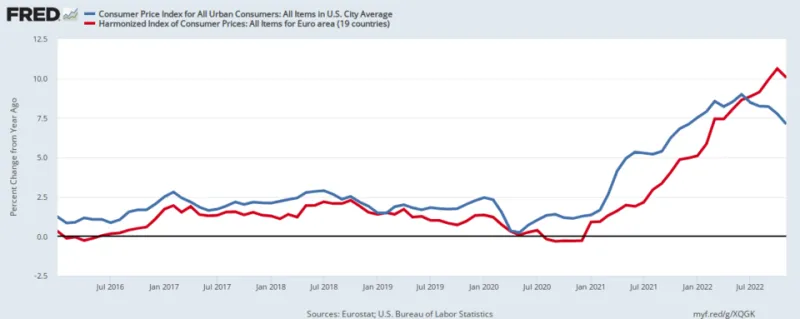
Photo: Federal Reserve Economic Data, Public domain, via Wikimedia Commons
Every month, a familiar ritual plays out across trading desks and home offices from New York to San Diego. Traders position themselves ahead of a major inflation release — the Personal Consumption Expenditures index, the Consumer Price Index, or the Producer Price Index — confident that their read on consensus is sound. Then the number drops. Within seconds, spreads blow out, stops get triggered, and the pair they were watching has already moved thirty, forty, sometimes sixty pips in the wrong direction. By the time a manual order reaches the market, the opportunity has closed and the damage is done.
This is the inflation-deflation forex trap in its most punishing form. And for active US traders, understanding why it happens — and how to position ahead of it — is one of the most valuable edges available in the current rate environment.
Why Rate Expectations Move Faster Than Reported Data
The Federal Reserve does not set monetary policy in a vacuum. It responds to data. And the market, knowing this, does not wait for the Fed to act — it prices in the probability of future action the moment new information becomes available. This creates a structural lag that most retail traders underestimate.
Consider how the mechanism works. When the Bureau of Economic Analysis releases PCE data that comes in above consensus — say, core PCE at 2.8% against an expected 2.5% — the interest rate futures market begins repricing almost immediately. Fed funds futures contracts shift within milliseconds, reflecting a higher probability of a rate hold or even a hawkish pivot. The US Dollar, sensitive to rate differentials, begins appreciating against major counterparts before the majority of discretionary traders have even finished reading the headline.
The irony is that the data itself is backward-looking. PCE measures consumption from the prior month. Yet the market's reaction is entirely forward-looking, recalibrating the entire expected path of Fed policy in real time. Traders who are positioned based on the old consensus — the one that existed before the release — are now caught on the wrong side of a repricing event they technically anticipated but could not act on quickly enough.
The Pairs Most Exposed to Consensus Dislocations
Not all currency pairs respond to US inflation surprises with equal velocity or magnitude. Understanding which pairs offer the highest signal-to-noise ratio during these events is critical for traders who want to front-run consensus shifts rather than react to them.
EUR/USD remains the most liquid and therefore the most immediately reactive pair to US data surprises. Because both the Federal Reserve and the European Central Bank are actively managing their own divergent inflation narratives, any US print that shifts the rate differential calculus hits EUR/USD with particular force. A hotter-than-expected PCE release tends to compress the pair sharply, often within the first sixty seconds of the release.
USD/JPY deserves special attention in the current environment. The Bank of Japan's historically accommodative stance — even as it makes incremental adjustments — means that rate differential sensitivity between the US and Japan remains exceptionally high. When US inflation surprises to the upside, USD/JPY has demonstrated a tendency to extend moves significantly beyond the initial spike, making it a pair worth watching for multi-hour continuation setups rather than just the initial knee-jerk reaction.
GBP/USD offers a more complex picture. The Bank of England's own inflation battle means that sterling can sometimes absorb USD strength more resiliently than the euro, creating divergent behavior between EUR/USD and GBP/USD during the same release window — a dynamic that attentive traders can exploit through relative value positioning.
Reading the Pre-Release Landscape
Sophisticated traders do not simply wait for the number to drop. They study the environment in the days and hours preceding a major inflation release, looking for signals that the market is already beginning to shift its consensus estimate.
One of the most reliable leading indicators is the behavior of short-duration Treasury yields. The two-year US Treasury yield is acutely sensitive to near-term Fed expectations. When it begins drifting higher in the forty-eight hours before a PCE release — without any obvious catalyst — it frequently signals that institutional positioning is already pricing in a hotter number. A corresponding USD bid across major pairs in that same window reinforces the signal.
Option market implied volatility is another tool worth monitoring. When one-day implied volatility on EUR/USD or USD/JPY spikes meaningfully above its thirty-day average in advance of a release, it indicates that large participants are hedging significant directional exposure. The direction of that hedging activity — readable through skew data — can offer a probabilistic lean on where smart money expects the surprise to land.
Managing the Whipsaw: Position Sizing Before the Print
For traders who choose to hold positions through inflation releases rather than flatten ahead of them, risk management is not merely important — it is existential. The whipsaw dynamic that characterizes post-release price action is not random noise. It reflects a genuine battle between the initial algorithmic reaction and the subsequent fundamental reassessment by discretionary participants.
A common and costly mistake is sizing a pre-release position the same way one would size a normal intraday trade. Spread widening alone during a major release can consume a significant portion of a trade's expected profit. Add in the possibility of a stop-out followed by a reversal back through the entry level — a scenario that plays out with uncomfortable regularity — and the case for reduced position sizing ahead of high-impact events becomes compelling.
Many experienced traders adopt a tiered approach: entering a core position based on their pre-release thesis at reduced size, then adding to the position only after the initial volatility subsides and the market demonstrates directional conviction. This approach sacrifices some of the initial move but dramatically reduces exposure to the whipsaw that so frequently traps traders who size aggressively into the print.
Timeframes That Offer the Best Post-Release Clarity
Once a release has dropped and the initial spike has played out, the question becomes which timeframe offers the most actionable signal for follow-through. Based on the behavior of major pairs across recent inflation release cycles, the fifteen-minute and one-hour charts tend to provide the clearest picture of whether the initial move has genuine momentum or is simply a liquidity vacuum reaction that will fade.
If the fifteen-minute candle following a major surprise closes strongly in the direction of the initial move — and subsequent candles do not immediately retrace more than fifty percent of that first candle — the probability of a sustained directional move over the next two to four hours increases meaningfully. Conversely, a rapid retracement to pre-release levels within the first two candles suggests that the market has absorbed the surprise and is returning to range, making continuation trades considerably less attractive.
The Strategic Takeaway
The gap between when inflation data surprises the market and when most traders can meaningfully adjust their positions is not going to narrow. If anything, the increasing speed of algorithmic reaction means that the window for discretionary traders continues to compress. The response to this reality is not to compete on speed — that is a battle retail traders cannot win. It is to compete on anticipation: studying rate expectation dynamics, reading pre-release signals in yield and volatility markets, and building positions that reflect where consensus is going rather than where it currently stands.
At SuperFX, the traders who consistently outperform are not the ones who react fastest to the headline. They are the ones who have already done the analytical work before the number ever hits the screen.